
Klyck.io Blog
Articles, news, tips, tricks and trends
Knowledge Management
Team collaboration
Project Management
Note-Taking management
Sales Enablement
Content Management
How PING Replaced Spreadsheets With Smarter Account Planning

January 26th, 2026
Company: Ping Golf
Industry: Sporting Goods
Website: ping.com
PING needed a better way to manage account plans across teams. Spreadsheets had served them well in earlier stages, but as their sales organization grew, the cracks started to show, inconsistent formats, siloed updates, and limited visibility were slowing teams down. By moving to Klyck, PING gained real-time visibility, consistency across the organization, and time back in their reps’ days — helping their sales teams shift focus from document management to strategy and growth.
The Challenge
PING’s account plans were previously stored in spreadsheets. While familiar and flexible, this approach created compounding challenges as teams scaled:
- Account information was difficult to track and maintain across a growing rep base
- Plans lacked consistency – different reps used different formats, making cross-team comparisons difficult
- Management had limited visibility into progress, activity, and where accounts stood at any given moment
- Updates were time-consuming, often duplicated, and siloed within individual inboxes or local drives
- Onboarding new reps meant walking them through informal, undocumented processes with no single source of truth
The bigger the team grew, the more fragile the system became. Leadership couldn’t get a reliable real-time picture of account health, and reps were spending valuable selling time maintaining documents instead of engaging customers.
The Solution
PING implemented Klyck to centralize and modernize its account planning process from the ground up.
With Klyck, teams transitioned from static, siloed spreadsheets to a structured, user-friendly platform built specifically for collaboration and visibility. Account plans became easier to create, customize, update, and maintain, while still following a consistent framework that everyone across the organization could follow.
Rather than chasing down the latest version of a file or reconciling competing spreadsheets, reps could now work from a single, always-current source. Templates standardized the planning process without removing flexibility, so teams could tailor plans to specific accounts while leadership could still compare and roll up activity across the board.
For management, Klyck provided real-time insight into account activity, progress, and performance, making it easier to coach reps, allocate resources, and make informed strategic decisions without waiting for a quarterly review.
The Impact
The shift to Klyck delivered immediate and measurable benefits across the sales organization:
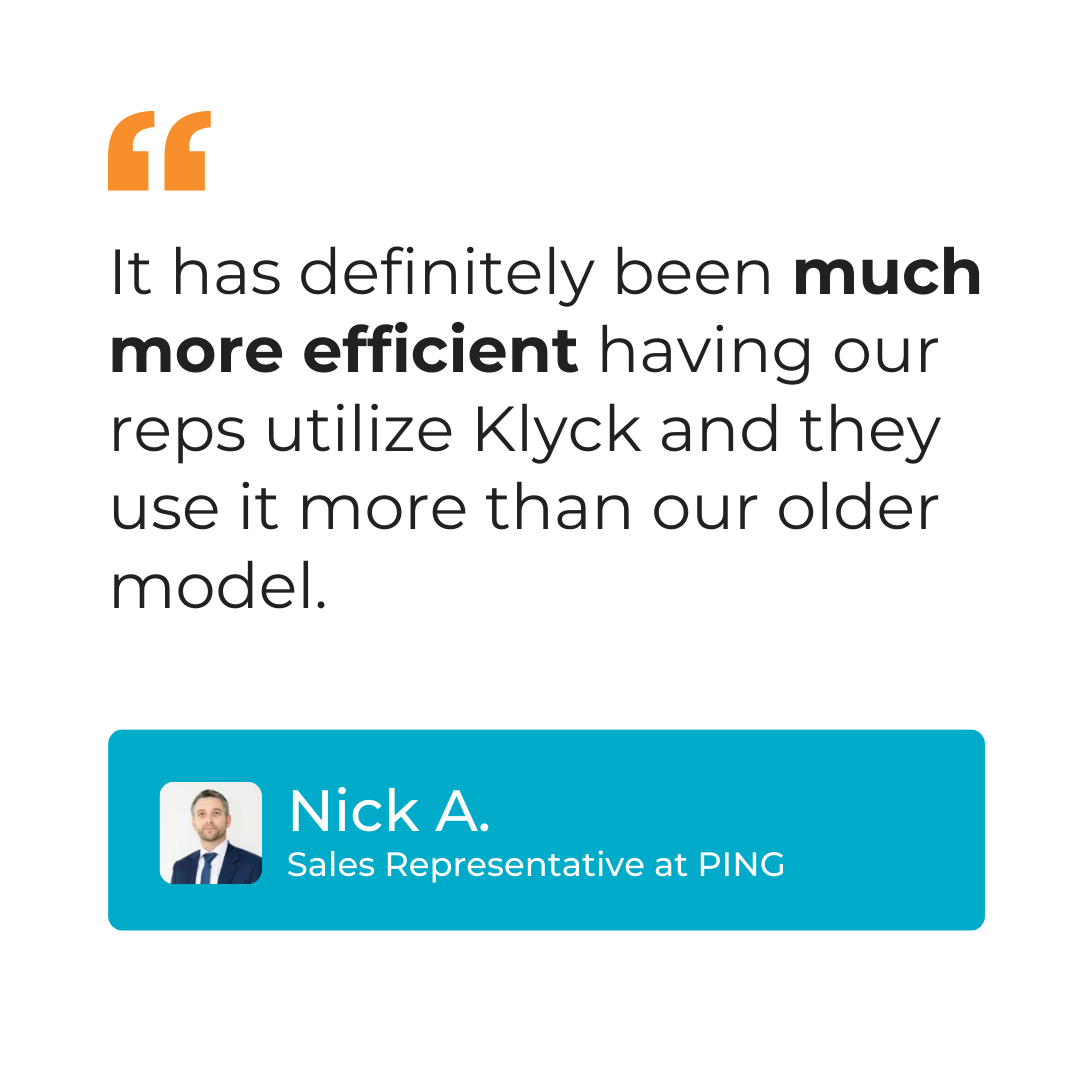
- Improved efficiency — reps spent significantly less time managing and updating account plans, freeing up hours each week for actual selling activity
- Real-time visibility — management gained a live window into sales activity, pipeline progress, and account health without relying on manual reporting
- Stronger strategic planning — clearer insights and better data meant smarter resource allocation and more targeted account strategies
- Consistent execution — a standardized framework meant every rep was working from the same playbook, reducing gaps and improving team-wide alignment
- Faster onboarding — new reps could ramp up faster with structured templates and a clear process already in place
- Time savings at scale — as the team grew, the efficiency gains compounded, allowing PING to scale their sales operation without scaling their admin burden
By reducing friction in their workflows, PING empowered its sales teams to work more effectively, more strategically, and with greater confidence in the data driving their decisions.
What the Team Had to Say
The Takeaway
PING’s success highlights a challenge that’s nearly universal among growing sales organizations: spreadsheets can only take you so far.
They’re easy to start with, but as teams grow and accounts multiply, the lack of structure and visibility becomes a liability. Version control breaks down. Formatting drifts. Insights get buried. And the time cost of maintaining everything manually quietly adds up.
By adopting Klyck, PING created a scalable, standardized approach to account planning, one that supports alignment, visibility, and performance without adding complexity or disrupting the way reps prefer to work. The platform met the team where they were and gave them a better path forward.
The result is a more focused team, cleaner data, clearer insights, and more time spent where it matters most: building relationships and driving results.
If your sales team is still running account planning out of spreadsheets, PING’s story is a good reminder that the switch doesn’t have to be painful, and the upside is significant.
Start 2026 With Better Content Management and Workflow Automation
Teams with clear content, efficient workflows, and automated processes will enter 2026 with a major advantage. Less time searching. Fewer manual steps. Better alignment. Faster decisions. A smoother workday.
If your organization is preparing for a more organized, more efficient year, this is the right place to begin.
Ready to streamline your content and workflows for 2026?
RECENT ARTICLES
Why Policies Get Stuck in the Approval Washing Machine
Someone writes a new policy and it goes to several people for review. One responds immediately. Another sends comments two weeks later. Someone forwards it to another manager who wasn’t originally involved.

Your ERP Runs the Transactions. Who Runs the Work Between Them?
Industry InsightsSome of the biggest operational gaps in manufacturing exist between systems, departments, documents, and people.Published on September 30th, 2026Manufacturers have invested heavily in technology. Enterprise resource planning (ERP) systems manage...
Why Engineering Changes Break Down Between Departments
Industry InsightsThe engineering is often the easy part. The handoffs are where things get complicated.Published on September 18th, 2026An engineering change can look deceptively simple. Change a component. Update a drawing. Get an approval. Release the new revision....
Manufacturers Have Optimized the Shop Floor
Manufacturers have spent decades improving the shop floor. Lean manufacturing, Six Sigma, automation, ERP, MES, quality systems and continuous improvement programs have transformed how production is managed. Processes are mapped. Standards are established. Cycle times are measured. Bottlenecks are identified. KPIs tell leaders whether performance is improving or slipping. Walk into a well-run manufacturing facility and there is a good chance the organization can tell you exactly what is happening on the production floor.

Your ERP Isn’t Broken. It Just Doesn’t Run the Whole Process.
ERP systems are very good at managing transactions. The problem is that many of your most important operational processes don’t begin and end inside the ERP.

You Have More Software Than Ever. Why Are the Same Operational Problems Still Here?
Manufacturers have invested heavily in ERP, MES, QMS, collaboration tools and automation. Yet spreadsheets, manual workarounds, tribal knowledge and disconnected processes remain everywhere. Why?
Actionable tips, tricks and trends