
Industry Insights
You Have More Software Than Ever. Why Are the Same Operational Problems Still Here?
Published on August 21st, 2026
Manufacturers have invested heavily in ERP, MES, QMS, collaboration tools and automation. Yet spreadsheets, manual workarounds, tribal knowledge and disconnected processes remain everywhere. Why?
A manufacturing operations executive recently made an observation that stuck with us.
More than 20 years ago, he was implementing ERP systems. Today, his organization has dramatically more technology at its disposal, yet many of the operational problems feel remarkably familiar.
That raises an uncomfortable question:
If manufacturers have more software, more data and more automation than ever before, why are so many critical processes still held together by spreadsheets, email, manual follow-up and tribal knowledge?
The answer may be that we’ve been very successful at digitizing parts of the business, without necessarily digitizing the entire way work gets done.
1. Most enterprise software solves a piece of the process
ERP is excellent at certain things. MES, QMS, CRM, WMS, SharePoint, etc., all have purposes. The problem occurs between them.
Customer order → engineering review → material availability → production planning → quality → shipping → invoicing
Different systems may own different pieces. But the actual process crosses systems, departments, documents, approvals, decisions and people.
Who owns the spaces between the systems?
2. People become the integration layer
We’ve encountered manufacturers where an integration between enterprise systems stopped working and, instead of restoring the integration, employees were added to manually re-enter information. Over time, the workaround became the process.
Employees:
- copy data from one system to another;
- email someone when something needs approval;
- maintain spreadsheets because the ERP doesn’t provide the visibility they need;
- message colleagues to determine status;
- manually reconcile information;
- remember exceptions that aren’t documented anywhere.
When people spend their day moving information between systems, people have become the middleware.
3. Workarounds become invisible
Management may see the official process: Order → ERP → production → shipping
But the real process might be: Order → email → spreadsheet → employee → ERP → Teams message → approval → employee → production → manual status update → shipping
And eventually nobody questions it. The workaround becomes institutionalized. Executives often have visibility into the system of record without having visibility into the actual process.
4. More software doesn't necessarily solve the problem
When organizations discover gaps, the natural response is often: Buy another application. But now employees have: ERP + MES + QMS + SharePoint + Teams + Excel + specialized applications + another workflow tool. Each might solve a legitimate problem. Collectively, they can create another one: fragmentation. So the question shouldn’t always be, “What software are we missing?” A better question may be, “Where is the actual process breaking down?”
5. Technology utilization matters as much as technology capability
An organization can possess data about:
- supplier lead times,
- historical consumption,
- inventory,
- predicted demand,
- production schedules,
and still have employees make purchasing decisions based largely on experience or gut feel. That’s not necessarily a technology gap. It’s a gap between
information → decision → action.
Having the data isn’t the same as using the data.
Having the workflow isn’t the same as following the workflow.
Having the software isn’t the same as changing how work gets done.
6. Start by finding the workarounds
Tell an Operations VP to walk through the organization and ask:
“Where are we using people to compensate for gaps in our systems or processes?”
Then give them five questions:
- Where are employees re-entering information?
- Which important processes still depend on spreadsheets?
- Where does someone have to email, message or call another person to keep a process moving?
- Which processes depend heavily on one experienced employee knowing what to do?
- Where does management lack real-time visibility into status, ownership or bottlenecks?
Don’t dismiss those as minor inefficiencies. They may be telling you where your real operational gaps are.
The next phase isn’t necessarily more software
Manufacturers don’t need another application for every problem.
They need a better way to connect the systems they already have with the people, documents, decisions and workflows required to actually execute the process. For operations leaders, the objective ultimately comes down to two things:
Visibility — Can I see what’s actually happening?
Control — Can I ensure the process is being executed the way we intended?
Where Klyck fits
Klyck helps operational teams manage the work that happens between people, documents and enterprise systems.
Rather than replacing ERP, MES, QMS or other systems of record, Klyck provides a workflow layer for processes that still rely on manual coordination, disconnected tools and tribal knowledge — giving teams greater visibility, accountability and control over execution.
Where are people acting as middleware in your organization?
If you’re trying to bring greater visibility and control to a critical operational process,
Related Operational
Insights
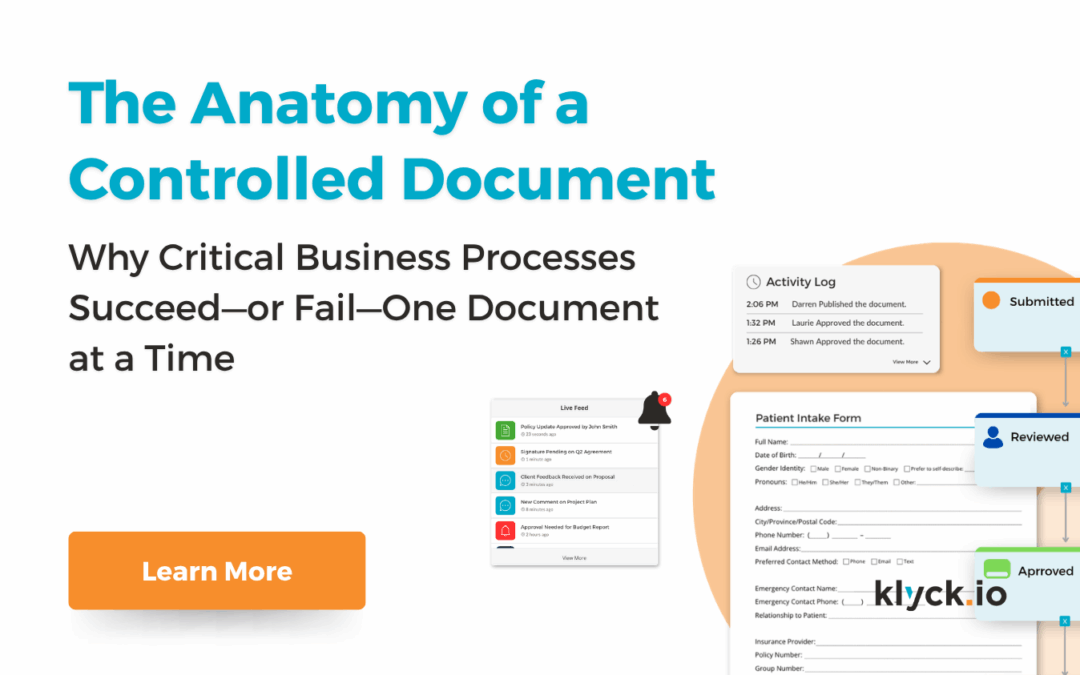
The Anatomy of a Controlled Document
Industry InsightsPublished on July 3rd, 2026Why Critical Business Processes Succeed—or Fail—One Document at a Time "Most organizations don't have a document problem. They have a control problem." Every Business Process Eventually Becomes a Document Process...
Engineering Change Request Workflow: A Complete Guide
Industry InsightsPublished on July 2nd, 2026How High-Performing Manufacturers Reduce Errors, Improve Accountability, and Keep Engineering Changes Moving Engineering Changes Rarely Fail Because of Engineering Every manufacturer eventually discovers the same...
Why SharePoint Struggles with Controlled Document Workflows
Industry InsightsPublished on May 20th, 2026For many organizations, SharePoint starts as a convenient way to store and share files. At first, it works well enough: Documents are centralized Teams can collaborate Files are accessible from anywhere But as organizations...
Worldox End-of-Life: What Teams Should Look for in a Replacement
Industry InsightsPublished on May 13th, 2026For many firms and document-heavy organizations, Worldox has been a familiar part of daily operations for years. But with support ending, many teams are now facing the same question: What comes next? For some organizations,...
OpenText Migration Guide
Industry InsightsPublished on May 13th, 2026Migrating away from OpenText Content Suite or Extended ECM is rarely just a document transfer project.Most organizations rely on OpenText for: Document lifecycle management Approval workflows Compliance policies Integrations...