Industry Insights
Email Is Quietly Ruining Your Most Critical Business Processes
Published on July 10th, 2026
The biggest risk isn’t that your team uses email. It’s that email has quietly become your workflow.
Walk through almost any organization and ask a simple question: “How does work actually get done?” The official answer is usually impressive.
“ERP, CRM, Document Management, Quality Systems, HR Platforms, Finance Software.”
But follow a single engineering change, policy update, proposal approval, or invoice through the organization and a different story usually unfolds.
- Someone emails a document.
- Someone replies with edits.
- Someone forwards it to another department.
- A new version gets saved.
- Someone forgets to copy a stakeholder.
- A meeting gets scheduled because nobody knows where the approval is.
A week later someone asks: “Which version are we actually using?”
The uncomfortable truth is this: Many organizations haven’t automated their most critical business processes. They’ve simply connected them with email.
Email Isn’t the Problem
Email became the workflow because nothing else did.
Email is one of the greatest communication tools ever created, but it was never designed to manage operational work.
It can’t reliably answer questions like:
- Who owns this?
- What’s waiting for approval?
- Which version is current?
- Who still needs to review it?
- What’s blocking the process?
- Can we prove what happened six months ago?
As organizations grow, those questions become far more important than the email itself.
Operational Chaos Doesn’t Happen Overnight
It grows one workaround at a time. Someone starts tracking approvals in Excel, another team creates a shared folder. Engineering keeps drawings on a network drive. Quality builds a spreadsheet. Finance creates another approval email. Marketing stores customer content somewhere else. Sales has a brand new presentation for every sales call which gets lost to the ether immediately afterwards.
Each solution makes sense on its own. Collectively, they create operational confusion.
Soon nobody is completely sure:
- Where work starts
- Where it finishes
- Who owns it
- Which information can be trusted
The Hidden Cost Isn’t Email
The hidden cost is uncertainty. When organizations lose visibility into operational work, they begin paying for it in ways that rarely appear on a balance sheet.
Engineering changes take longer. Policies aren’t consistently followed. Invoices sit waiting for approval. Quality teams work from outdated procedures. Sales shares the wrong presentation. Customers receive conflicting information.
Approvals become meetings. Meetings become delays. Delays become operational risk.
None of those problems begin with email.They begin because the work itself has no system of record.
Operational Truth
Email isn’t ruining your business. It’s revealing where your operational workflows no longer scale.
That’s an important distinction. The goal isn’t to eliminate email. The goal is to ensure email is used for communication, not for managing critical business processes.
What High-Performing Organizations Do Differently
Organizations with mature operational workflows don’t ask employees to remember where work is.
The process remembers. Every request has:
- An owner
- A current status
- An approval history
- A complete audit trail
- A next step
People spend less time asking: “Has this been approved?” and more time doing meaningful work.
Visibility replaces follow-up. Structure replaces uncertainty. Accountability replaces assumptions.
It Starts With One Workflow
Most organizations don’t replace email overnight. They start with one process. An engineering change. A policy approval. An incident report. An invoice. A proposal. One workflow becomes repeatable. Then another. Then another.
Over time, operational work moves out of email and into structured workflows that everyone can see, understand, and trust. That’s how organizations gain operational control—not by replacing communication, but by improving how work moves.
How Klyck Helps
Klyck helps organizations replace document-driven processes that rely on email, spreadsheets, and shared folders with structured workflows that create visibility, accountability, and consistency.
Whether you’re managing engineering changes, policy approvals, quality processes, invoices, proposals, or customer onboarding, every workflow follows the same principle:
Operational work deserves a system of record—not another email thread.
Related Operational Insights
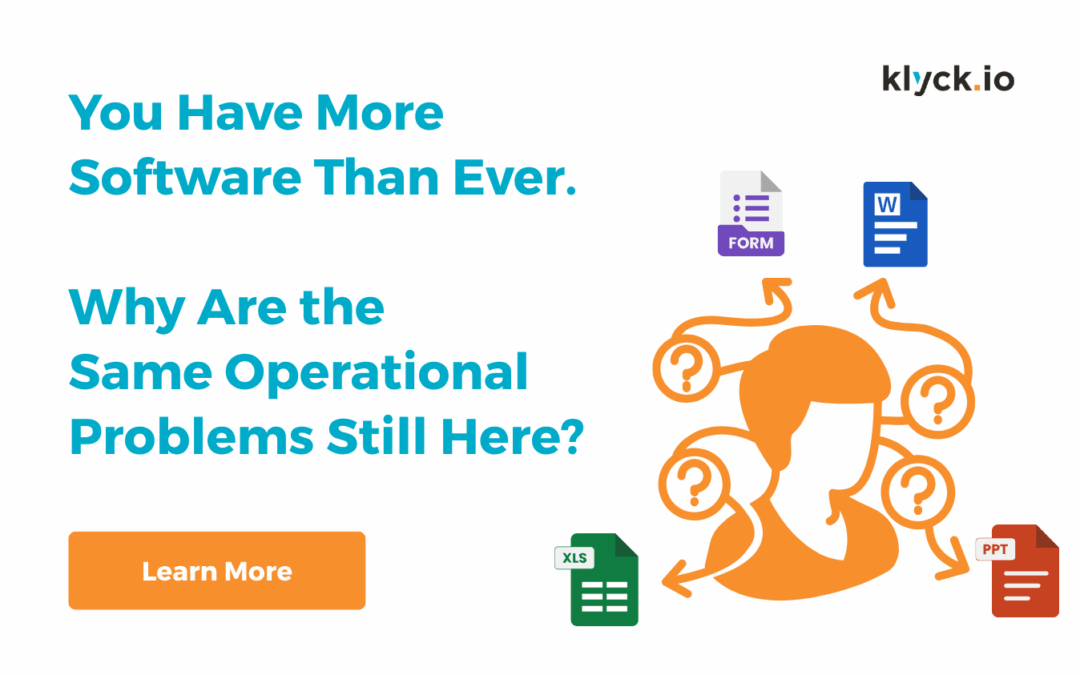
You Have More Software Than Ever. Why Are the Same Operational Problems Still Here?
Manufacturers have invested heavily in ERP, MES, QMS, collaboration tools and automation. Yet spreadsheets, manual workarounds, tribal knowledge and disconnected processes remain everywhere. Why?
How Teams Simplify SOP Approvals and Revision Control
Standard operating procedures are only effective when teams trust they are using the correct version.
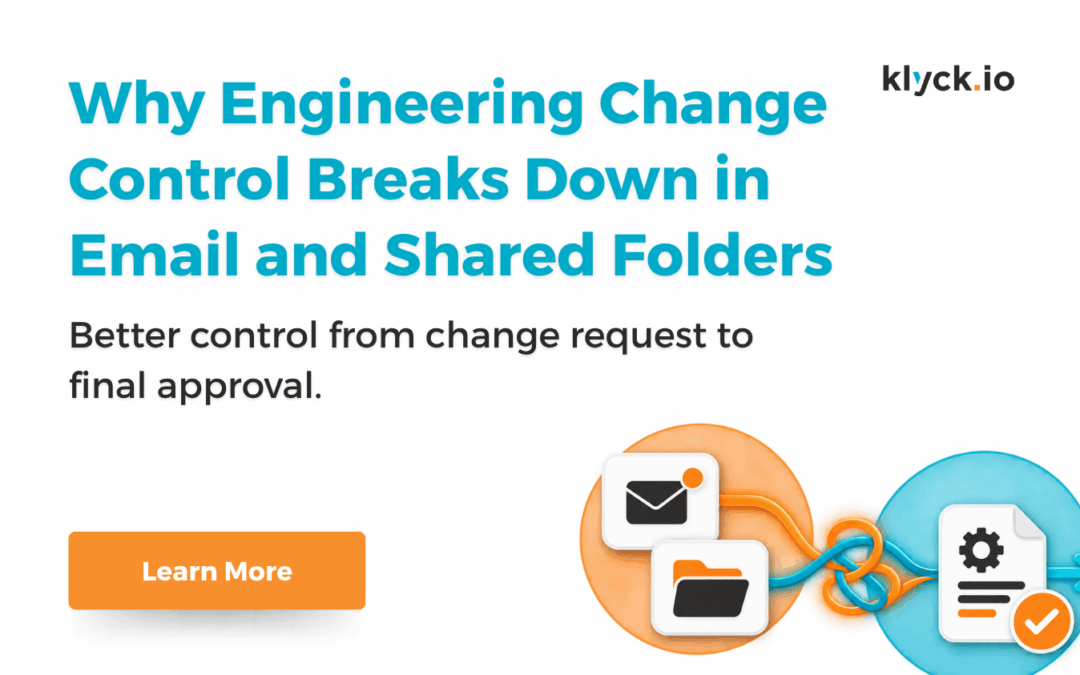
Why Engineering Change Control Breaks Down in Email and Shared Folders
Engineering change processes are rarely simple. Even small changes often require coordination between engineering, quality, operations, etc. But in many organizations, engineering change workflows still rely heavily on email approvals, spreadsheets and shared folders. As manufacturing operations grow, those manual processes become increasingly difficult to control. The result is often delayed approvals, version confusion and missing accountability.
How Manufacturing Teams Reduce Approval Delays and Version Conflicts
Manufacturing teams often lose valuable time to slow approvals, unclear document ownership, and conflicting file versions. Learn how structured workflows, centralized document control, automated approvals, and better lifecycle visibility can help reduce delays, strengthen accountability, and keep operational processes moving efficiently across departments.
Policy Approval Workflow for Healthcare
A policy only protects patients and staff if the right people are following the current, approved version, not last year’s draft still floating around. See how healthcare organizations structure policy approval, version control, and staff notification to stay audit-ready year-round.
Ready to Improve One Workflow?
You don’t need to transform your entire organization.
Start with one business process that’s still running through email.
We’ll help you map the workflow, identify bottlenecks, and show you how organizations are replacing operational uncertainty with operational control.