
Industry Insights
How Manufacturing Teams Reduce Approval Delays and Version Conflicts
Published on August 13th, 2026
In many manufacturing organizations, operational processes still depend heavily on documents moving between departments.
Engineering changes, SOP revisions, quality procedures, vendor documentation, and production approvals all require coordination across multiple teams.
But in many environments, those workflows still rely on email approvals, shared folders, spreadsheet tracking, manual follow-ups and disconnected systems.
Common symptoms include:
- Delayed approvals
- Uncertainty around document status
- Conflicting document versions
- Inconsistent processes
- Difficulty tracking accountability
As manufacturing organizations grow, these issues become increasingly difficult to manage manually.
Why Approval Delays Happen
Most approval bottlenecks are not caused by employees refusing to participate. They happen because the process itself lacks visibility and structure. Common issues include:
- Approvers not being notified consistently
- Unclear ownership
- Documents getting buried in email threads
- Manual routing between departments
- Uncertainty about which version is current
When processes rely heavily on manual coordination, delays become inevitable.
This becomes especially problematic for engineering change control, SOP approvals, quality documentation, controlled revisions, production-related documentation.
The Cost of Version Confusion
One of the biggest operational risks in manufacturing environments is uncertainty around document versions.
Teams need confidence that:
- The latest approved version is being used
- Outdated procedures are no longer accessible
- Revisions are tracked properly
- Approval history is visible
- Changes are controlled consistently
Without clear version control, organizations often experience rework, production errors, inconsistent execution, audit concerns and operational confusion. The larger the organization becomes, the more difficult manual control becomes.
Why Email-Based Approvals Break Down
Many organizations initially manage approvals through email because it feels simple.
But as workflows grow, email quickly becomes difficult to manage.
Common problems include:
- Unclear approval status
- Missing responses
- Duplicate versions
- Inconsistent review processes
- No centralized audit visibility
Employees often waste time trying to answer basic questions:
- Who approved this?
- Is this the latest version?
- Where is the document stuck?
- Which revision is active?
Those inefficiencies compound across departments.
What Modern Manufacturing Teams Need
Manufacturing organizations increasingly need systems that combine:
- Document control
- Workflow management
- Lifecycle visibility
- Structured approvals
- Audit accountability
The goal is not simply storing files. The goal is improving how operational processes move.
Simplicity Is Often the Missing Piece
Many organizations assume stronger governance requires more complicated systems. In reality, overly complex workflows often reduce adoption. When processes become difficult to use, employees naturally create workarounds such as side conversations, local copies, unmanaged edits and email approvals. That weakens both visibility and control. The most effective workflow systems balance:
- Structure
- Usability
- Accountability
- Operational flexibility
Teams are more likely to follow processes that are clear and easy to use consistently.
A Better Approach to Controlled Workflows
Modern manufacturing teams are increasingly moving toward workflow systems that provide:
Modern manufacturing teams are increasingly moving toward workflow systems that provide:
- Centralized document control
- Automated approvals
- Lifecycle management
- Role-based routing
- Clear audit history
This helps reduce:
- Approval delays
- Version conflicts
- Operational confusion
- Process inconsistency
It also improves visibility across departments. As manufacturing operations grow, controlled workflows become less about compliance alone and more about operational efficiency. When approvals move faster and document ownership becomes clearer, teams spend less time managing process confusion and more time moving work forward.
Related Operational Insights

The Ultimate Guide to Knowledge Management
Learn how to identify and capture key knowledge, create a knowledge management system that works for your organization, and effectively share knowledge with your team.

The Ultimate Guide to Sales Enablement
Everything from defining sales enablement and its benefits to creating a sales enablement strategy that works for your business.
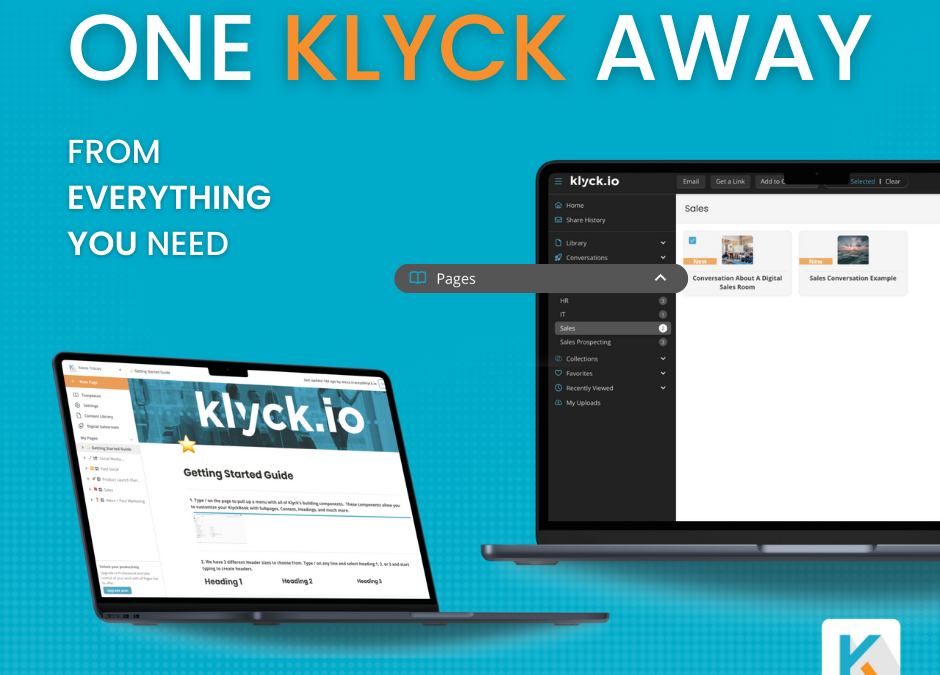
Elevating Sales Efficiency: Introducing the Powerful Integration of Klyck App + Pages
Klyck.io Blog Articles, news, tips, tricks and trends Elevating Sales Efficiency: Integrating Klyck App + Pages At Klyck, we are excited to introduce our groundbreaking integration between our two products, Klyck App and Pages, seamlessly combining content...
SharePoint vs. Sales Enablement Tools
Klyck.io Blog Articles, news, tips, tricks and trendsSharePoint vs. Sales Enablement Tools I’m just going to put this out there – and it won’t be the last time in this blog that I do – SharePoint is not the same as sales enablement. SharePoint is great at what it...

A Simplified Guide to Sales Enablement
Klyck.io Blog Articles, news, tips, tricks and trendsA Simplified Guide to Sales Enablement Wondering what sales enablement is? Consider this article the Cliff’s Notes version. Together, we’ll go through the details of what makes it work, how develop a strategy, and...
Still managing approvals through email threads and shared folders?
Modern workflow systems can help manufacturing teams improve document control, reduce approval delays, and maintain clearer operational visibility.