
Industry Insights
Manufacturers Have Optimized the Shop Floor. What About Everything Else?
Published on August 21st, 2026
Manufacturers have spent decades improving the shop floor. Lean manufacturing, Six Sigma, automation, ERP, MES, quality systems and continuous improvement programs have transformed how production is managed. Processes are mapped. Standards are established. Cycle times are measured. Bottlenecks are identified. KPIs tell leaders whether performance is improving or slipping. Walk into a well-run manufacturing facility and there is a good chance the organization can tell you exactly what is happening on the production floor.
But walk upstairs and ask the same questions about the processes surrounding production, and the answer can be very different.
The Other Side of Manufacturing
Consider the work happening every day across engineering, quality, purchasing, finance, HR, customer service and operations.
An engineering change needs review and approval. A quality issue requires investigation and follow-up. A customer complaint moves between departments. A supplier issue needs documentation and resolution. A new employee needs to complete a series of onboarding steps. A policy or procedure needs to be reviewed, updated and approved.
None of these processes happen on the production line. But they all affect how effectively the business operates.
And in many organizations, they are still coordinated through a combination of email, spreadsheets, meetings, shared drives and the knowledge of experienced employees.
The contrast is striking.
We’ve spent enormous effort optimizing how products move through a plant. We haven’t necessarily applied the same discipline to how work moves through the rest of the organization.
When employees become the integration layer
On the shop floor, variation is the enemy. If five operators perform the same process five different ways, most manufacturers would investigate why. Yet outside production, that kind of variation can be surprisingly normal. Ask five people how a particular approval gets completed and you may get five different answers.
- Who needs to review it?
- What information is required?
- Where does the supporting documentation live?
- What happens when something is rejected?
- How long should the process take?
- Who follows up when it stalls?
Often, the real process exists partly in a procedure and partly in the heads of the people who perform it. That’s tribal knowledge, and tribal knowledge works, until it doesn’t. People leave. Organizations grow. Responsibilities change. Volumes increase. Acquisitions happen. Regulatory requirements become more demanding.
Suddenly, a process that worked when everyone knew what to do becomes difficult to manage.
The Invisible Queue
There’s another important difference between production and transactional work.
Visibility.
If work begins piling up at a workstation on the production floor, people notice. If purchase requests, engineering reviews, corrective actions or approvals start piling up in someone’s inbox, the bottleneck can remain almost invisible.
Management may see the symptom: “We need another person,.” but they may not see the underlying process.
- How many items are waiting?
- Where are they waiting?
- How long have they been there?
- Why are they getting stuck?
- How much work is being sent back?
- Which step actually creates the delay?
Without that visibility, adding capacity can become the default solution to what is actually a process problem.
What Would Lean Look Like Outside the Plant?
The principles aren’t particularly different. Understand the current state.
- Define the desired process.
- Establish ownership.
- Standardize the work.
- Measure performance.
- Identify bottlenecks.
- Continuously improve.
The difference is that transactional work is harder to see, there isn’t a physical production line to observe. The “product” might be an engineering change, approval, quality review, customer request or document and instead of physically moving from workstation to workstation, it moves between people, departments and systems. That makes the process easier to ignore;, it doesn’t make it less important.
The Next Productivity Opportunity?
Manufacturers will continue investing heavily in automation, robotics, AI and smarter production systems.
They should.
But there may be another significant productivity opportunity hiding in plain sight. Look at the work surrounding the factory floor.
- How much depends on email?
- How many processes are tracked in spreadsheets?
- How many approvals disappear into inboxes?
- How much institutional knowledge exists primarily in people’s heads?
- How easily can management see where work is accumulating?
- How consistently are those processes performed across departments, facilities or business units?
- And perhaps most importantly: How many of those processes are actually measured?
Manufacturing has become extraordinarily sophisticated at understanding the movement of materials through production. The next opportunity may be applying some of that same discipline to the movement of information, decisions and work throughout the rest of the organization.
Because you can’t improve what you can’t see.
Related Operational
Insights

Policy Approval Workflow for Healthcare
Industry InsightsPublished on July 30th, 2026How Healthcare Organizations Keep Policies Current, Approved, and Ready for Accreditation Healthcare organizations depend on policies to ensure safe, consistent care. A policy isn't valuable simply because it exists—it is...

Email Is Quietly Ruining Your Most Critical Business Processes
Industry InsightsPublished on July 10th, 2026The biggest risk isn’t that your team uses email. It’s that email has quietly become your workflow. Walk through almost any organization and ask a simple question: “How does work actually get done?” The official answer is...
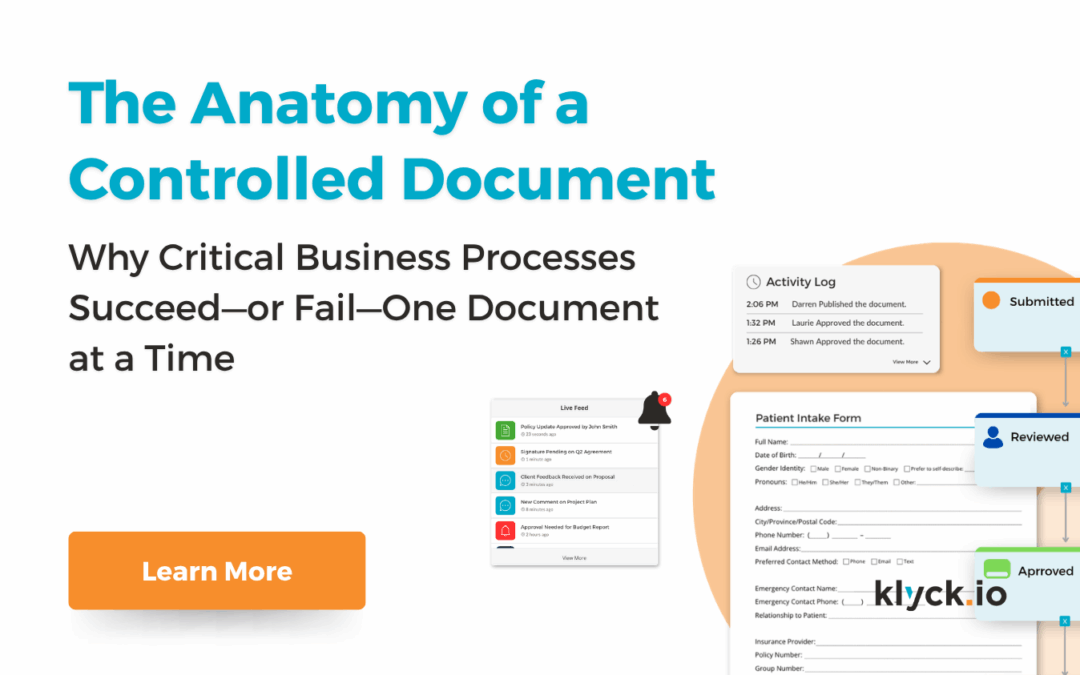
The Anatomy of a Controlled Document
Industry InsightsPublished on July 3rd, 2026Why Critical Business Processes Succeed—or Fail—One Document at a Time "Most organizations don't have a document problem. They have a control problem." Every Business Process Eventually Becomes a Document Process...

Engineering Change Request Workflow: A Complete Guide
Industry InsightsPublished on July 2nd, 2026How High-Performing Manufacturers Reduce Errors, Improve Accountability, and Keep Engineering Changes Moving Engineering Changes Rarely Fail Because of Engineering Every manufacturer eventually discovers the same...
Why SharePoint Struggles with Controlled Document Workflows
Industry InsightsPublished on May 20th, 2026For many organizations, SharePoint starts as a convenient way to store and share files. At first, it works well enough: Documents are centralized Teams can collaborate Files are accessible from anywhere But as organizations...

Worldox End-of-Life: What Teams Should Look for in a Replacement
Industry InsightsPublished on May 13th, 2026For many firms and document-heavy organizations, Worldox has been a familiar part of daily operations for years. But with support ending, many teams are now facing the same question: What comes next? For some organizations,...

OpenText Migration Guide
Industry InsightsPublished on May 13th, 2026Migrating away from OpenText Content Suite or Extended ECM is rarely just a document transfer project.Most organizations rely on OpenText for: Document lifecycle management Approval workflows Compliance policies Integrations...

OpenText vs Modern ECM Platforms: What Has Changed
Klyck.io Blog Articles, news, tips, tricks and trendsOpenText vs Modern ECM Platforms: What Has ChangedEnterprise content management has changed dramatically over the past decade. Platforms like OpenText were originally designed for large enterprise infrastructure...