
Industry Insights
Why Policies Get Stuck in the Approval Washing Machine
Writing the policy is often the easy part. Getting it reviewed, approved, published, and kept current is where things get complicated.
Published on October 7th, 2026
Someone writes a new policy and it goes to several people for review. One responds immediately. Another sends comments two weeks later. Someone forwards it to another manager who wasn’t originally involved.
The author makes the changes and sends out a new version. More comments arrive. Some are based on the previous version. Another revision is created, another round of reviews begins, and eventually someone asks a surprisingly difficult question:
Who are we waiting for?
The policy has entered the approval washing machine. It keeps going around and around, but nobody is quite sure when it’s going to come out.
The problem isn’t writing the policy
Most organizations know how to create a policy. The harder problem is managing everything that happens between the first draft and the final approved version.
- Who owns it?
- Who needs to review it?
- Who can make changes?
- Which comments still need to be addressed?
- Which version is everyone reviewing?
- Who has approved it?
- Who is holding it up?
When that process happens through email, shared folders, Word documents and meetings, visibility disappears quickly.
The policy itself may be perfectly organized. The process around it isn't.
Every Review Creates Another Handoff
Policies often need input from multiple departments. A new policy might begin with HR or Compliance but require input from Operations, Legal, Finance, Quality, IT, or senior leadership. Each reviewer brings an important perspective, but every additional reviewer also creates another handoff.
The document gets sent out, comments come back, and changes are made. The policy gets recirculated, someone asks for another change and a new version is created.
Without a structured process, the author often becomes the workflow engine—tracking comments, managing versions, reminding reviewers, and trying to determine when everyone is finally satisfied.
The process works because someone keeps pushing it forward.
Nobody Wakes Up Excited to Approve a Policy
There is another practical problem with policy approvals: they usually aren’t the reviewer’s highest priority.
Managers have customers, employees, meetings, deadlines, and dozens of other things competing for their attention. A policy sitting in their inbox is easy to postpone. That’s why a good policy process can’t depend on people remembering what they need to do.
Reviewers need to know when something requires their attention. They need reminders when it hasn’t been completed. The policy owner needs to see where the process is stalled without sending another round of emails asking for updates.
The goal isn’t to nag people; it’s to make ownership visible.
Approval Isn’t the End
Even after a policy receives final approval, the process isn’t finished. The approved version needs to be published. Employees need access to the correct version. Previous versions may need to be retired. Some policies require employees to acknowledge that they have read them. Review dates need to be scheduled so policies don’t quietly become outdated. That makes policy management a lifecycle:
- 1CreateDraft & assign an owner
- 2ReviewReviewers notified & reminded
- 3ReviseComments tied to each version
- 4ApproveSign-offs recorded
- 5PublishCurrent version goes live
- 6AcknowledgeEmployees confirm they've read it
- 7Review againNext review scheduled automatically
- ↻ The cycle repeatsBack to Create, with full history
Simply storing the final document solves only one part of that lifecycle.
Publishing a Policy Isn’t the Same as Controlling It
A shared drive, intranet, or document repository can make policies available to employees, but availability doesn’t necessarily mean control.
Can you immediately identify the current approved version? Can you see who approved it and when? Can you retrieve the previous version? Do you know when the policy is due for review? If acknowledgement is required, can you prove who has completed it?
These questions become particularly important when an auditor, regulator, employee, or manager needs an answer. At that point, finding the policy isn’t enough; you need to be able to reconstruct its history.
Operational Truth
A policy isn’t controlled because you know where it’s stored. It’s controlled when you know who owns it, which version is current, who approved it, and who needs to act on it.
One Policy. One Visible Process.
A better approach is to treat the policy and its approval process as one connected record. The owner can see where the policy stands. Reviewers know when action is required. Comments and revisions remain connected to the process. Approvals are recorded. The approved version is published, previous versions remain part of the history, and future reviews can be scheduled automatically. Instead of asking “Who has the policy?”, everyone involved can see what happens next.
Klyck helps organizations manage that complete policy lifecycle, connecting documents, reviewers, revisions, approvals, publication, acknowledgements, and recurring reviews in one controlled workflow.
Because policies shouldn't spend months going around in circles. Eventually, they need to come out of the washing machine.
Related Operational
Insights
Policy Approval Workflow for Healthcare
Industry InsightsPublished on July 30th, 2026How Healthcare Organizations Keep Policies Current, Approved, and Ready for Accreditation Healthcare organizations depend on policies to ensure safe, consistent care. A policy isn't valuable simply because it exists—it is...

Email Is Quietly Ruining Your Most Critical Business Processes
Industry InsightsPublished on July 10th, 2026The biggest risk isn’t that your team uses email. It’s that email has quietly become your workflow. Walk through almost any organization and ask a simple question: “How does work actually get done?” The official answer is...
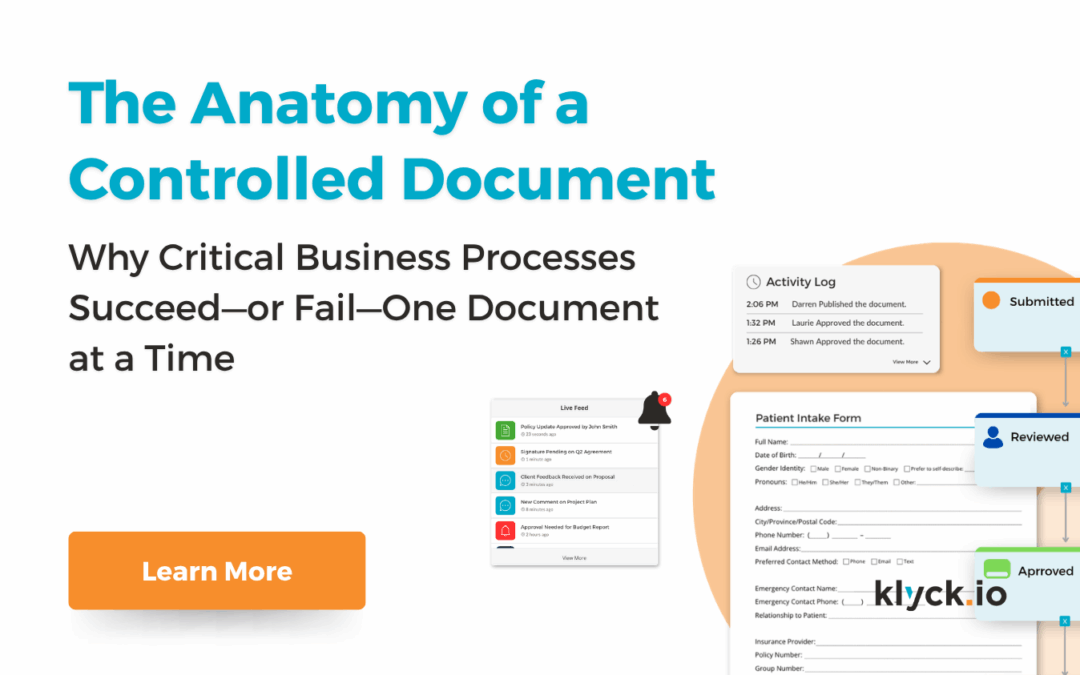
The Anatomy of a Controlled Document
Industry InsightsPublished on July 3rd, 2026Why Critical Business Processes Succeed—or Fail—One Document at a Time "Most organizations don't have a document problem. They have a control problem." Every Business Process Eventually Becomes a Document Process...
Engineering Change Request Workflow: A Complete Guide
Industry InsightsPublished on July 2nd, 2026How High-Performing Manufacturers Reduce Errors, Improve Accountability, and Keep Engineering Changes Moving Engineering Changes Rarely Fail Because of Engineering Every manufacturer eventually discovers the same...
Why SharePoint Struggles with Controlled Document Workflows
Industry InsightsPublished on May 20th, 2026For many organizations, SharePoint starts as a convenient way to store and share files. At first, it works well enough: Documents are centralized Teams can collaborate Files are accessible from anywhere But as organizations...
Worldox End-of-Life: What Teams Should Look for in a Replacement
Industry InsightsPublished on May 13th, 2026For many firms and document-heavy organizations, Worldox has been a familiar part of daily operations for years. But with support ending, many teams are now facing the same question: What comes next? For some organizations,...
OpenText Migration Guide
Industry InsightsPublished on May 13th, 2026Migrating away from OpenText Content Suite or Extended ECM is rarely just a document transfer project.Most organizations rely on OpenText for: Document lifecycle management Approval workflows Compliance policies Integrations...
OpenText vs Modern ECM Platforms: What Has Changed
Klyck.io Blog Articles, news, tips, tricks and trendsOpenText vs Modern ECM Platforms: What Has ChangedEnterprise content management has changed dramatically over the past decade. Platforms like OpenText were originally designed for large enterprise infrastructure...